Pro telemetry dashboard preview
Combine Anti-Cheat × Anti-Piracy into one layer
MOD APK redistribution, SpeedHack, memory tampering, Injection, build tampering, save tampering, and Steam bypass launches
then detect and respond to those major threats through policy.
A commercial Unity security SDK built around Native protection for Android · iOS · Windows · macOS · Linux · Steam, with limited WebGL protection.
Zero-Config Integration
Import the package, open OZero Security > Config & Dashboard from the Unity editor menu, toggle the modules you need, and save the asset. No scene hierarchy management or manual component placement required.
Low / Standard / Strict presets — each preset now applies genuinely distinct thresholds and toggles across every module
Multi-platform Unity support: Android, iOS, Windows, WebGL, Unity Editor, Steam
Layered runtime protection
OZero combines build integrity, runtime configuration, native protection, and operations telemetry. Developers can apply consistent detection and response policies without writing complex security code themselves.
Signed release baselines help verify that the player is running the intended build configuration.
Signed build baseline
Checks release files and runtime environment signals to reduce use of modified builds.
Build integrity
Enabled modules are prepared at runtime without placing security objects in every scene.
Zero scene setup
Native protection assists runtime validation outside the managed code layer.
Native runtime guard
A single check is rarely enough for live operations. OZero separates build, runtime, memory, and server telemetry observations to improve both defensive quality and operational visibility.
Layered Security Coverage
Detect the major paths of game hacking across multiple layers and respond through configurable policy.
Detects tampering with major DLLs and data files.
C++ native integrity cross-validation raises the cost of modified builds and MOD APK redistribution.
Verifies if the app was installed via authorized stores like Google Play. Prevents sideloading through black markets or APK sharing.
Extracts unique hardware fingerprints to bind save data to the device. Prevents copying and sharing save files across devices.
Multi-thread timer and web timestamp cross-validation instantly detects TimeScale manipulation and system clock tampering.
Multi-endpoint round-robin · no public time-server dependencyPrecise distance algorithms compensating for network latency block abnormal movement (teleport) and wall hacks.
Observes abnormal runtime modules, hook indicators, and suspicious execution states, then responds with telemetry or blocking based on policy.
Protects core values such as HP, gold, and speed through Native C++ Secure Types while keeping most gameplay logic unchanged.
Fast and secure encryption/decryption of save data and important asset files. Uses device-unique authentication keys.
Replaces Unity's default PlayerPrefs. Obfuscates and encrypts both keys and values to prevent data theft via registry dumps.
Checks Steam App ID, launch path, ownership/DLC, Build ID, and release steam_appid.txt hygiene to detect non-Steam launches and known emulator traces. Server-side ownership verification is available in Pro.
Live Demos
Real hacking tools vs OZero Security — watch each security module block real attacks live.
Attempting to find in-game Gold and HP values with Cheat Engine — comparing before and after OZero in real time.
The moment a speed hack app triples the game speed, OZero's 3-layer native detection system fires immediately.
OZero detects abnormal runtime injection signals and responds with telemetry or blocking according to your configured security policy.
A process injection attempt via Cheat Engine's debugger feature — instantly detected and blocked by OZero's injection monitor.
When HxD hex editor directly modifies a save file, message authentication verification instantly detects the tampering.
Copying a save file to another device is immediately invalidated by key-derivation function device binding.
On Windows Standalone, the moment a speed hack app is launched, OZero's multi-thread timer cross-validation fires instantly.
Why Native C++?
See the structural difference proved by memory scan simulation — what C# alone cannot protect against.
C# security solutions embed the protection algorithm directly inside the C# code. Because C# can be decompiled using free tools, an attacker can read the algorithm, understand how it works, and reverse the encryption in minutes.
OZero Security never stores raw values in C# managed memory. All data lives exclusively in native C++ heap, encrypted with per-instance dedicated encryption keys. The token returned to C# shifts every frame — making memory scanners return 0 results by design.
Raw values never enter managed memory. IL2CPP or Mono — the data stays native.
Each variable gets its own encryption key. Cracking one reveals nothing about others.
The C#-side token changes every frame. Static memory scanners see a constantly shifting target.
No heap allocations during encrypt/decrypt. Security that doesn't tax your frame budget.
Core Differentiators — Boot Chain & Key Operations
Why OZero
Without targeting any specific product, this summarizes what each category of security SDK guarantees — and what it does not. Every row is verifiable against OZero's code and manual.
| Criterion | OZero Security | Memory-protection-focused SDKs | Server-side anti-cheat services |
|---|---|---|---|
| Self-verifying boot chain (4 stages) | ✓Layered validation combining Trust Anchor, Manifest, Bootstrapper, and Native Guard | ✗Disable a single entry point and the whole thing falls | ~Server-side verification only; no client boot-time self-check |
| Native runtime response | ✓Runtime threat response assisted by a layer outside managed code | ✗Primarily depends on managed-code callbacks | ✗Server verdict first; local client response requires separate setup |
| Per-variable keyed memory encryption | ✓Native C++ memory + per-variable key + Zero-GC | ~Mostly XOR/masking, shared key, GC allocations possible | ✗Client memory protection is out of scope |
| Build integrity signature verification | ✓OZero authenticated signature signatures | ~Checksum-based, weak key separation | ✓Server-side verification possible, but requires network |
| Dual-fingerprint zero-downtime key rotation | ✓Expected + Previous fingerprints both accepted — no forced update | ✗Single fixed key — rotation requires forced update for all users | ~Server-side rotation possible, requires client cooperation |
| Time-tampering defense (multi-endpoint) | ✓Multiple webTime endpoints — round-robin + quorum (majority) verification | ~Single time-server dependency | ✓Server clock authoritative; client cannot verify alone |
| No public time-server dependency | ✓Register your own webTime endpoints freely — zero external dependency | ✗Public time-server hardcoded | ~Uses your server clock, but you bear the operating cost |
| Hooking-tool detection (Frida etc.) | ✓Native memory scan + C# layer cross-checks | ~C#-level detection only; native hooks undetected | ✗Hook detection is out of scope |
| iOS build-time guard | ✓BuildFailedException blocks the build if the iOS native bridge is missing | ✗Manual check required; no build-time guard | N/A |
| Server infrastructure dependency | ✓Offline-capable — all verification runs on the client | ✓Standalone-capable | ✗Server/network required — not viable for offline games |
| Pricing model | ✓$129 perpetual (Standard) / $399/year (Plus Add-on) / $1,499/year or $399 first month then $149/month (Pro Add-on) | ~Per-asset pricing varies; major-version upgrades may require repurchase | ✗Monthly subscription or MAU-based metered pricing |
| Server telemetry (optional) | ✓Pro tier: OZA Attestation · Cloud Telemetry · Auto-block | ✗Not supported | ✓Required — cannot operate without server connection |
| Serverless mode | ✓Fully serverless on Standard tier — no key, zero external dependencies | ✓Standalone-capable | ✗Not supported — server/network required |
This comparison reflects the typical implementation patterns of each category and does not target any specific product. ✓ meets / ~ partial / ✗ does not meet, or out of category.
Live Ops
An SDK isn't only needed on launch day. Key rotation, post-mortem analysis, time verification, build guarding, and cloud telemetry (optional) — the tools live ops actually relies on.
Expected + Previous key fingerprints enable zero-downtime key rotation. Old and new builds coexist on the same server without branching — no forced update required.
Telemetry includes module, layer, risk score, and event state so operations teams can classify patterns and track trends.
Multiple webTime endpoints called in round-robin; only the quorum (majority) result is trusted. Verification keeps running if one endpoint goes down, with no public time-server dependency.
If the iOS native bridge is missing, BuildFailedException blocks the build. The accident of shipping an unprotected build to the App Store is caught at build time.
Enabled from the Pro tier — violation events aggregate on the server so you can analyse abort-code distribution, device distribution, and violation trends. If the server goes down, graceful degradation keeps core security fully alive.
Pro-tier feature — the SDK trusts an Ed25519 signing keypair through an active + previous dual-key model. Operators trigger a rotation from the customer portal's Server Keys page, run a grace window, then explicitly retire the old kid — no forced SDK update required.
Operating modes
Standard completes client-side protection with no server. Plus blocks attack reuse with per-customer Native Variants, and Pro adds server attestation, telemetry, and auto-block to harden live-service operations.
All verification completes on the client. Zero external infrastructure dependency.
Recommended use cases
→ Standard tier covers this fully
Everything in Plus, plus server verification, an operations dashboard, real-time alerts, and automatic threat-blocking policies.
Respond to tampered builds, repeat-risk devices, and risky-country traffic through live operations policy.
Recommended use cases
→ Pro tier
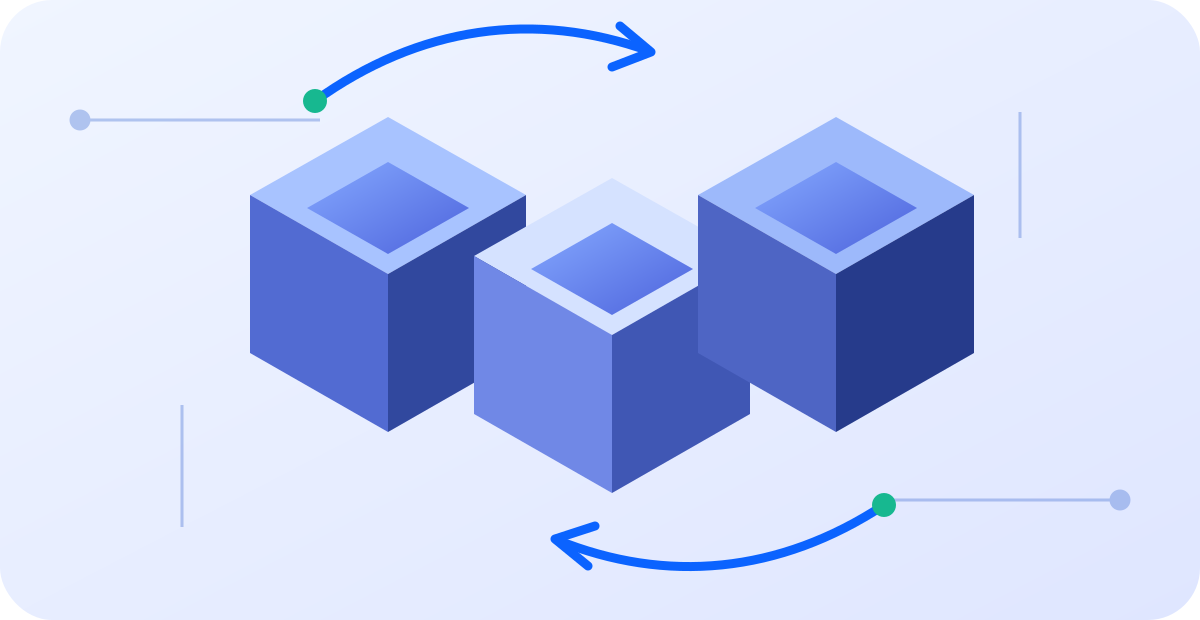
OZero Plus/Pro doesn't ship one shared security binary to every customer. It defends along two axes — distribution (space) and renewal (time) — so an attack analyzed on one game can't be reused as-is against another target or the next version.
Binaries are distributed from a carefully engineered pool of native Variants. This structurally lowers the chance that a bypass or auto-patch technique found on one game can be reused as-is against another target.
Every regular SDK update rebuilds and refreshes the native Variants. The defense surface shifts before analysis is complete, so even a bypass that worked once is quickly neutralized.
Pro Operations
OZA attestation verifies build and Steam evidence on the server side, while the dashboard and Discord alerts make risk visible. Teams with a game server can validate tokens directly, while teams without one can delegate allow/warn/block decisions to OZero Managed Verification.
Your game server or OZero Managed Verification checks the token for tampered builds, Steam ownership, and blocked-build state.
Block repeat-risk devices, blocked Variants, vulnerable build versions, and risky-country traffic through server and OZero edge policy.
Aggregate threat events by module, platform, SDK version, and device, then keep the evidence operators need.
Override key SpeedHack and Injection parameters per license.
Server maintenance, network failure, and expired/suspended/revoked licenses quietly downgrade Pro features to the Standard/serverless path instead of closing the game. Confirmed security states such as build tampering, blocked builds, injection/hooking, or debugger detection follow the configured threat-response policy. The client cache is protected with a device-bound key and uses a default 7-day TTL.
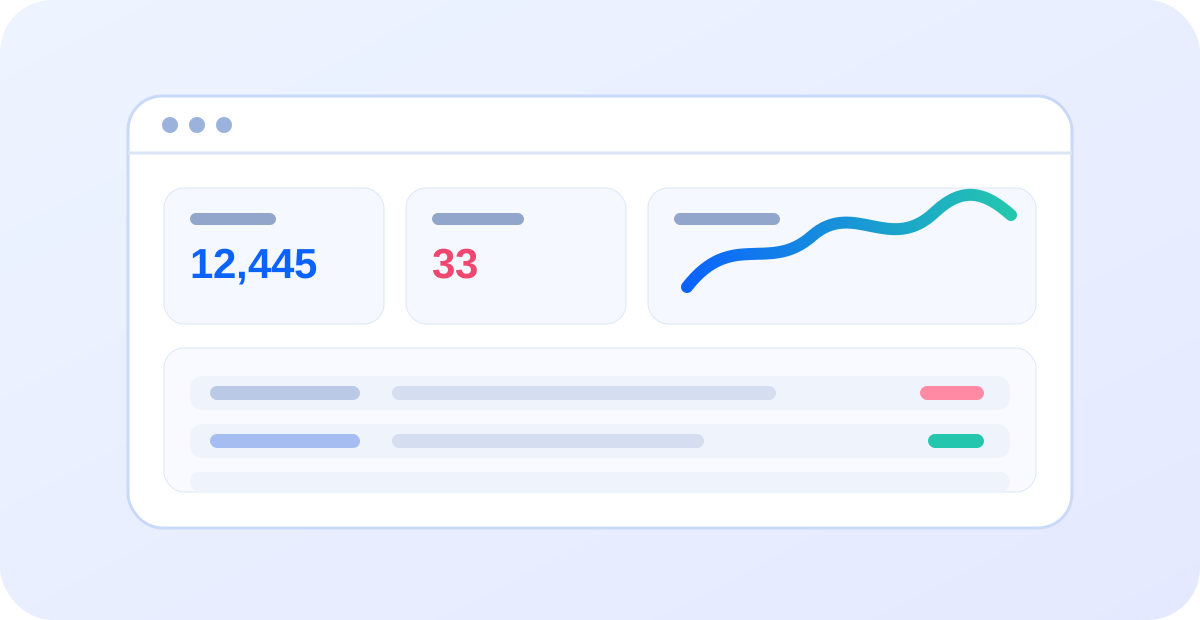
Pro telemetry dashboard preview
Adjust detection strength and policy refresh cadence per license, then apply it on the next client config sync.
Review events, platforms, SDK versions, and risk scores in one place to track attack patterns after launch.
Block repeat-risk devices through server policy and apply the decision on relaunch or device policy heartbeat.
Register reviewed modules by hash and signer while keeping suspicious modules visible for operator follow-up.
Protection model
Standard starts fast with local protection, while Pro adds server verification and operational control for live-service response.
| Comparison item | Serverless mode (Standard) | Server-bound mode (Pro) |
|---|---|---|
| 10 core security modules | ✓Fully supported | ✓Fully supported (identical) |
| External infrastructure | ✓None | ~Cloudflare Workers + D1 + KV |
| Cloud Telemetry | ✗Not available | ✓Available (graceful degradation) |
| Signed Time | ✓Local time + multi-endpoint webTime quorum | ✓Server-signed timestamps + quorum verification |
| Automatic blocking policy | ✗Not available | ✓Policy blocks, Variant blocks, vulnerable-version blocks, and edge country blocks managed server-side |
| Server keys / policy operations | N/A | ✓Server key rotation, blocking policy, customer portal management |
| Operations overhead | No separate server to operate | OZero provides the server features — no infrastructure for you to build. |
| Recommended pricing tier | $129 (Standard · perpetual) $399/year (Plus Add-on · app-specific Native Variant) - Standard required |
$1,499/year or $399 first month then $149/month (Pro Add-on) - Standard required |
Standard detects local attack signals and responds through configured policy. Plus separates each customer game with Native Variants so attacks analyzed against one game are harder to reuse against another. Pro attests build-integrity and Steam validation results on the server, then automates post-launch response through telemetry, device blocking, and remote policy.
The scores below are internal simulation reference indicators, not a third-party certification or absolute security guarantee. Scores may vary by test scope, SDK version, platform, and configuration.
Uses the shared native module plus 10 local security modules to detect memory tampering, speed hacks, injection, build modification, and Steam bypass-launch signals on the client, then respond through configured policy.
A bypass patch built for one game does not work as-is against another customer game because each customer game is isolated with a different Native Variant.
Server integration verifies Build Integrity + Steam Guard more strictly, then reduces response time with telemetry, alerts, and policy / Variant / vulnerable-version / edge country blocking.
10 security modules + boot chain + local whitelist registration. Conservatively scored against the current default config before release preset enforcement.
Adds a project-specific Native Variant on top of Standard local defense. A bypass patch analyzed from one game becomes difficult to reuse as-is against another customer game.
An operations security score combining server validation, OZA attestation, telemetry, customer portal, alerts, and policy / Variant / vulnerable-version / edge country blocking.
Runtime module observation, trusted-module management, and risk-scored telemetry support operator decisions.
OZero proprietary encryption stack with public-key signatures. Quarterly server key rotation.
Customer portal, risk scores, real-time alerts, automatic blocking, and audit trails help operators see and respond to real attack flows.
Your game server can validate OZA tokens directly, or teams without a backend can receive a build/security verdict from OZero Managed Verification.
Internal reference scores · external groups estimated from public information and market assumptions · not a third-party certification
Single-release or small live game. The baseline assumes minimal server operations while defending against ModAPK, memory tampering, speed hacks, and injection.
Long-running game with recurring updates, repeated attacks, operations dashboard needs, device blocking, and remote policy adjustments.
| Solution group | Indie | Live Service | Estimated Cost | Notes |
|---|---|---|---|---|
| OZero Pro | 9.3 | 9.1 | $1,499/year/project or $399 first month + $149/month/project | Server validation + telemetry + alerts + policy / Variant / vulnerable-version / edge country blocking |
| OZero Plus | 8.5 | 7.7 | $399/year/project | Strengthens the security tier with Standard plus a project-specific independent Native module |
| OZero Standard | 8.2 | 7.2 | $129 one-time | Local protection focus. Fast adoption without server operations |
| User-mode SDK groups A·B·C | 5.0–7.0 | 4.0–5.8 | $50–$300 one-time | Similar-price Unity assets. No server validation, license validation, or operations response |
| Managed integrated suites X·Y·Z | 8.2–8.7 | 8.3–8.8 | $10k–$100k+ / year | Kernel + managed ops console. Strong defense, but higher annual cost and operational contract burden |
| Store-platform integrated | 6.0 | 6.6 | Based on store policy and fees | Limited to a single storefront |
| Kernel-driver solutions P·Q | 9.3–9.5 | 9.4–9.6 | $50k–$500k+ / year | Kernel-mode strength · console SDKs · higher price, permission, and operations cost |
Group definitions — Unity Asset Store user-mode security Assets A·B·C · server-linked anti-cheat solutions X·Y·Z · kernel-grade large anti-cheat solutions P·Q. Costs are estimate-based and may vary by contract, traffic, platform, and support scope.
Deployment and validation cases
These cards summarize observable outcomes after protection was applied: delayed MOD APK updates, runtime coverage by platform, and clear protection boundaries.
Real-World Signal
After protection was applied, an Android MOD maintained by a high-activity maintainer in a public MOD APK community was not immediately updated in a stable form. User crash and abort reports were observed, and the update flow was interrupted or delayed.
Verified Runtime Coverage
Windows IL2CPP and Android are the strongest primary protection targets. Runtime validation has also been completed on iOS, macOS, and Linux around Build Integrity, Injection, SpeedHack, and MemoryHack flows.
Clear Boundaries
WebGL runs in a browser environment where the Native C++ security logic cannot operate, so it should be treated as limited protection with simple runtime checks and integrity hints.
Standard is a perpetual license. Plus/Pro are Add-ons for projects with an active Standard license. Plus is annual-only, while Pro supports monthly or annual billing. Pro separates the 10K Telemetry Analysis Cap from the 100K MUAD scope for one project. If a project exceeds that scope or needs expansion, we review a Business or Enterprise plan change separately.
Serverless client SDK
All 10 security modules included
One-time payment · perpetual license
A perpetual license. Use every local security module immediately after package import, with no added subscription.
All 10 security modules + fully serverless operation. No license key, no server activation.
Serverless Ownership
The baseline protection layer that runs inside your project without external server dependency.
Recommended: offline / single-player titles
App-specific Native Variant protection
Add-on for Standard-licensed projects
one project · Standard add-on price (+$129 lifetime if not owned) · annual billing only · active Variant delivery · quiet downgrade to Standard on expiry
Adds a different Native Variant for each customer app. An attack analyzed against one game cannot be reused against another customer game as-is. If a Mod APK appears, rotating the Variant can invalidate the existing bypass patch.
Variant Isolation
Separates games so a bypass patch built for one game does not work against another as-is.
Recommended: indie and mid-sized games that need ModAPK reuse resistance
Server-bound for live ops
Add-on for Standard-licensed projects
Setup fee waived
one project · Standard add-on price (+$129 lifetime if not owned) · 10K Telemetry Analysis Cap · 100K MUAD · $1,499/year or $399 first month + $149/month after · quiet downgrade to Standard on expiry
Annual billing waives the setup fee and saves $539 compared with monthly billing for one year. It is the strongest choice for long-term live operations.
Pro is scoped to one project and includes everything in Plus, plus stronger server verification, an operations dashboard, real-time alerts, and automatic blocking policies. The default scope is a 10K Telemetry Analysis Cap and 100K MUAD. If a project exceeds that scope or needs expansion, we review a Business or Enterprise plan change separately.
Stronger Security
Build Integrity and Steam Guard are verified again on the server side.
OZA attestation adds a server-side layer to local checks, connecting tampered builds, Steam bypass launches, and blocked build states to your game server or OZero Managed Verification policy.
Recommended: live games / IAP / multiplayer
Low-friction purchase
Enter only company name, project name, Bundle ID, and confirm Standard ownership during checkout.
Selective verification
Proof of purchase is not required by default. We may request Standard entitlement confirmation only when needed.
Annual value
Plus is annual-only. Pro annual billing waives the setup fee and saves $539 compared with monthly billing for one year, making it the best value for long-term operations.
Security modules included across all 3 tiers
Core local security modules are included in all 3 tiers. Plus/Pro are Add-ons for projects with an active Standard license. The purchase flow starts with company name, project name, Bundle ID, and a Standard ownership checkbox. Proof of purchase is requested only when needed, and when the active period ends, shipped apps gracefully downgrade to Standard protection.
Everything you need to know before buying.